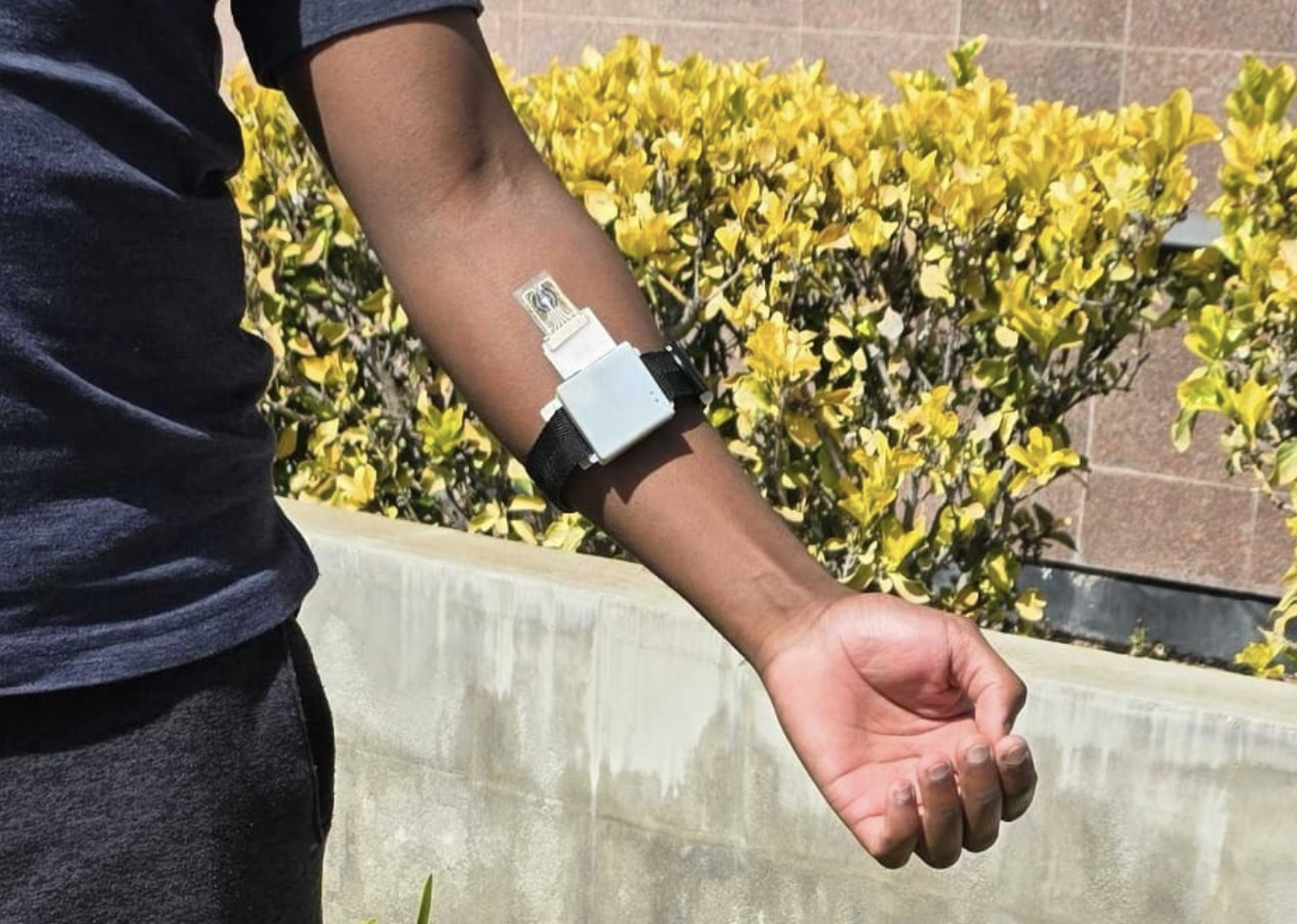
A team of engineers at the University of California, Irvine has developed a thin, wireless patch that can read the chemistry of human sweat for weeks at a time, a step researchers say could move continuous health monitoring out of the clinic and into everyday life.
The flexible device—formally, the In-Situ Regeneratable, Environmentally Stable, Multimodal, Wireless, Wearable Molecular Sweat Sensing System, or IREM‑W2MS3—adheres to the skin like a bandage and communicates with a standard Android smartphone or a custom wristwatch-style reader.
By analyzing a user’s perspiration in real time, it can simultaneously track four molecules: cortisol, glucose, lactate and urea, biomarkers tied to stress response, metabolism, exertion and kidney function.
Rahim Esfandyar‑pour, an assistant professor of electrical engineering and computer science who led the work, said the technology aims squarely at the growing burden of chronic disease.
“Chronic illnesses and stress-related conditions affect hundreds of millions of people worldwide, making early diagnosis and consistent health monitoring essential in reducing disease burden and improving patients’ quality of life,” he said in an interview released by the university.
A sensor that refreshes itself
Wearable devices that promise to track health markers are hardly new, but most struggle when asked to operate for more than short stretches of time outside controlled laboratory conditions. In many systems, Esfandyar‑pour said, target molecules accumulate on the sensing surface, gradually dulling the device’s ability to detect fresh signals; others rely on enzymes or antibodies that degrade with changes in temperature, humidity or pH.
The UCI patch tries to solve that problem by effectively restoring its own sensing surface while it is being worn. As the device operates, it periodically applies a low voltage to the sensing layer, a jolt that releases bound molecules and restores the sensor’s “sensitivity and selectivity without manual cleaning, replacement or intervention,” the research team reports.
In laboratory tests, the regeneration cycle produced “a nearly full recovery rate across multiple cycles,” according to the researchers, allowing the patch to function continuously over a 21‑day trial under varying pH and temperature conditions without measurable signal degradation. They argue that such environmental stability is essential if molecular sensing is to move from research labs into homes, workplaces and athletic fields.
No battery, but on‑demand sweat
Another obstacle for sweat-based monitoring is more basic: how to get enough fresh perspiration to analyze without sending users to the treadmill. The IREM‑W2MS3 sidesteps that by drawing power wirelessly from a near‑field communication–enabled smartphone or a dedicated reader, rather than relying on an internal battery.
When the phone or reader is held close to the patch, the induced electromagnetic field supplies a small electric current to a biocompatible hydrogel embedded in the device. That current triggers the hydrogel to stimulate sweat production locally, allowing the system to “generate and collect sweat samples without requiring strenuous physical activity,” the team notes.
Because the sensor can both coax out perspiration and clear its own surface, Esfandyar‑pour argues, it is suited to “stable, ongoing and long-term sweat monitoring” well beyond brief stress tests or supervised sessions.
“By being able to refresh itself, generate sweat and be worn for long durations outside of laboratory or clinical settings, the device offers users a health monitoring platform that is robust and highly practical,” he said.
Four molecules, many potential uses
The choice of biomarkers reflects an ambition to capture a wide slice of human physiology. Cortisol, a hormone released in response to stress, can offer clues about anxiety, depression and dysregulation of the brain’s stress circuitry; glucose is central to prediabetes and diabetes management; lactate provides a window onto physical exertion and metabolic health; and urea tracks kidney function.
By following those four molecules together and over time, the patch can provide “a broader picture than devices that monitor only one biomarker,” the researchers say. Potential uses they cite range from chronic disease management and sports performance to stress and mental health monitoring, preventive medicine and remote community health programs.
“Applications for the IREM‑W2MS3 are numerous and varied,” Esfandyar‑pour said. “We designed this wearable to be durable, easy to use and highly reliable.”
For now, the device remains a research prototype, but the team has filed a patent application through UC Irvine’s Beall Applied Innovation office and is exploring manufacturing and commercialization pathways.
From campus lab to wider world
The work, published in the journal Nature Biomedical Engineering, was carried out by a group of graduate students and postdoctoral researchers in UCI’s Department of Electrical Engineering and Computer Science, alongside Esfandyar‑pour. Co‑authors include postdoctoral scholar Jerome Rajendran and doctoral students Xiaochang Pei, Anita Ghandehari, Shingirirai Chakoma, Jorge Tavares‑Negret and Sahar Najafi‑Khoshnoo.
The project was funded by UC Irvine’s Samueli School of Engineering, which has made precision health and wearable bioelectronics a focus area. University officials say the sweat sensor is emblematic of a broader push to use flexible electronics and low‑power communication technologies to track health continuously, rather than in occasional clinic visits.
If devices like the IREM‑W2MS3 prove reliable outside the lab, they could eventually help physicians monitor patients with chronic disease at home, alert athletes and workers to overexertion before injury, or quietly log stress levels over the course of a workday.
For now, the patch offers a glimpse of what that future might look like: a small square of electronics on the arm, talking to a phone, turning beads of sweat into streams of data.