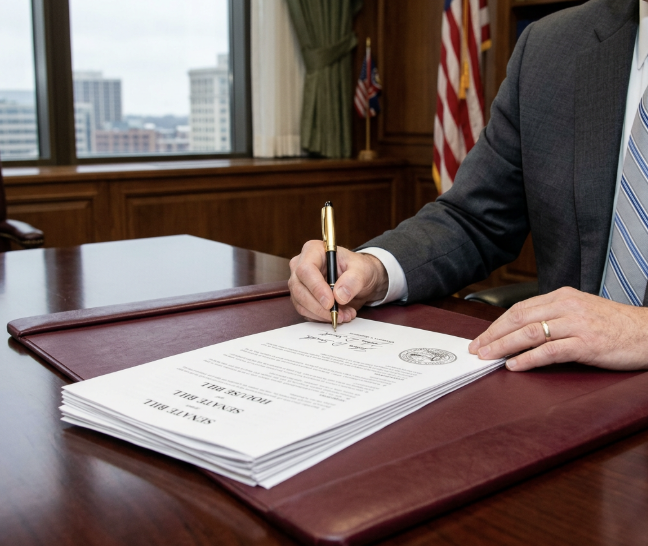
SACRAMENTO — With the June primary finished and fears of political interference rising, Governor Gavin Newsom has been quietly but steadily adding new laws to California’s books, capped by an election‑security measure that he and allies describe as a firewall against federal overreach.
In late May, Newsom signed Senate Bill 73, an election‑protection bill that took effect immediately and is explicitly aimed at shielding California’s voting system from outside interference, including from federal law enforcement under President Donald Trump. The law bars any person — federal agents included — from accessing voting machines, voter rolls or other election technology without a court order and empowers state officials to block law‑enforcement deployments at polling places and county election offices absent a clear public‑safety threat. It also makes it a felony to remove ballots from the custody of county registrars, a direct response to past incidents in which local authorities seized ballots and disrupted the chain of custody.
Newsom framed the bill as an answer to “legitimate anxiety” about Trump’s tactics in Democratic‑led jurisdictions and signaled that California intends to set its own rules for how elections are run, regardless of pressure from Washington. Civil‑rights groups and Democratic lawmakers lauded the measure as a national model for insulating local administrators from political intimidation, while Republicans and some conservative commentators warned it could hamstring legitimate investigations into election irregularities.
“I expect the worst with Trump because he’s done the worst,” Newsom said at a news conference, according to The Guardian.
In response, White House spokeswoman Abigail Jackson said, “Instead of levying false attacks at the President, Newscum should look in the mirror.” “Newscum” is Trump’s derogatory nickname for Newsom.
“This is the craziest thing I’ve ever seen,” said Riverside County Sheriff Chad Bianco.
Even as SB 73 grabbed the national spotlight, the governor’s official legislative updates show a quieter stream of less dramatic but still consequential bills crossing his desk in 2026. On June 1, Newsom signed AB 1768, a measure by Assemblymember Isaac Bryan of Los Angeles that grants Los Angeles and Contra Costa counties expanded authority to levy local sales taxes above the usual statewide cap, subject to voter approval. The law, chaptered as an urgency statute and effective immediately, allows Los Angeles County to seek an extra transactions and use tax of up to 0.5 percent and Contra Costa County up to 0.625 percent, potentially unlocking hundreds of millions of dollars for transportation, housing or other local priorities if future measures win at the ballot box.
Supporters argue the additional taxing flexibility is critical for counties struggling to pay for infrastructure and social‑service demands that Sacramento has increasingly pushed down to local governments. Critics, including taxpayer advocates, say the measure exacerbates California’s already high cost of living and creates a patchwork of sales‑tax rates that can confuse consumers and businesses alike.
Earlier in the spring, Newsom signed AB 2156, a symbol‑laden bill that renames the March 31 state holiday long known as Cesar Chavez Day to “Farmworkers Day.” Authored by Assembly Speaker Robert Rivas of Salinas and Senate President pro Tem Monique Limón of Santa Barbara, the measure passed with unanimous support in the Legislature and included an urgency clause, meaning the change took effect as soon as the governor’s pen left the page.
Under existing law, March 31 already marked a day of remembrance for Chavez, the iconic labor leader who helped organize California farmworkers into a political and economic force. By broadening the holiday into Farmworkers Day, lawmakers say they intend to honor not just the movement’s founding figure but the hundreds of thousands of agricultural workers — many of them immigrants — who keep the state’s multibillion‑dollar food system running. The California Department of Education has urged school districts to use the newly renamed holiday to teach students about the farmworker movement’s civil‑rights legacy and the ongoing struggles over wages, housing and workplace safety in the fields.
Taken together, the governor’s most recent signatures underscore the competing pressures shaping California politics in 2026: an election system under strain, local governments seeking more fiscal autonomy and a Democratic establishment eager to reaffirm its alliances with the workers and communities that form its base. SB 73, designed to harden the state’s ballot‑handling rules before a contentious midterm season, stands out as the marquee measure, but the quieter tax and holiday bills offer a glimpse of how Newsom and legislative leaders are using urgency statutes and symbolic gestures to move quickly on both policy and messaging.
For now, the governor’s office has released only a handful of legislative updates in 2026, suggesting many of the year’s most sweeping fights — on housing, climate policy, criminal justice and the state budget — still lie ahead. But as campaigns accelerate and lawsuits mount, the laws Newsom has already signed may provide a preview of the terrain on which California will contest its political future: who controls elections, who pays for local priorities and who gets written into the state’s civic calendar as a protagonist of its ongoing story.