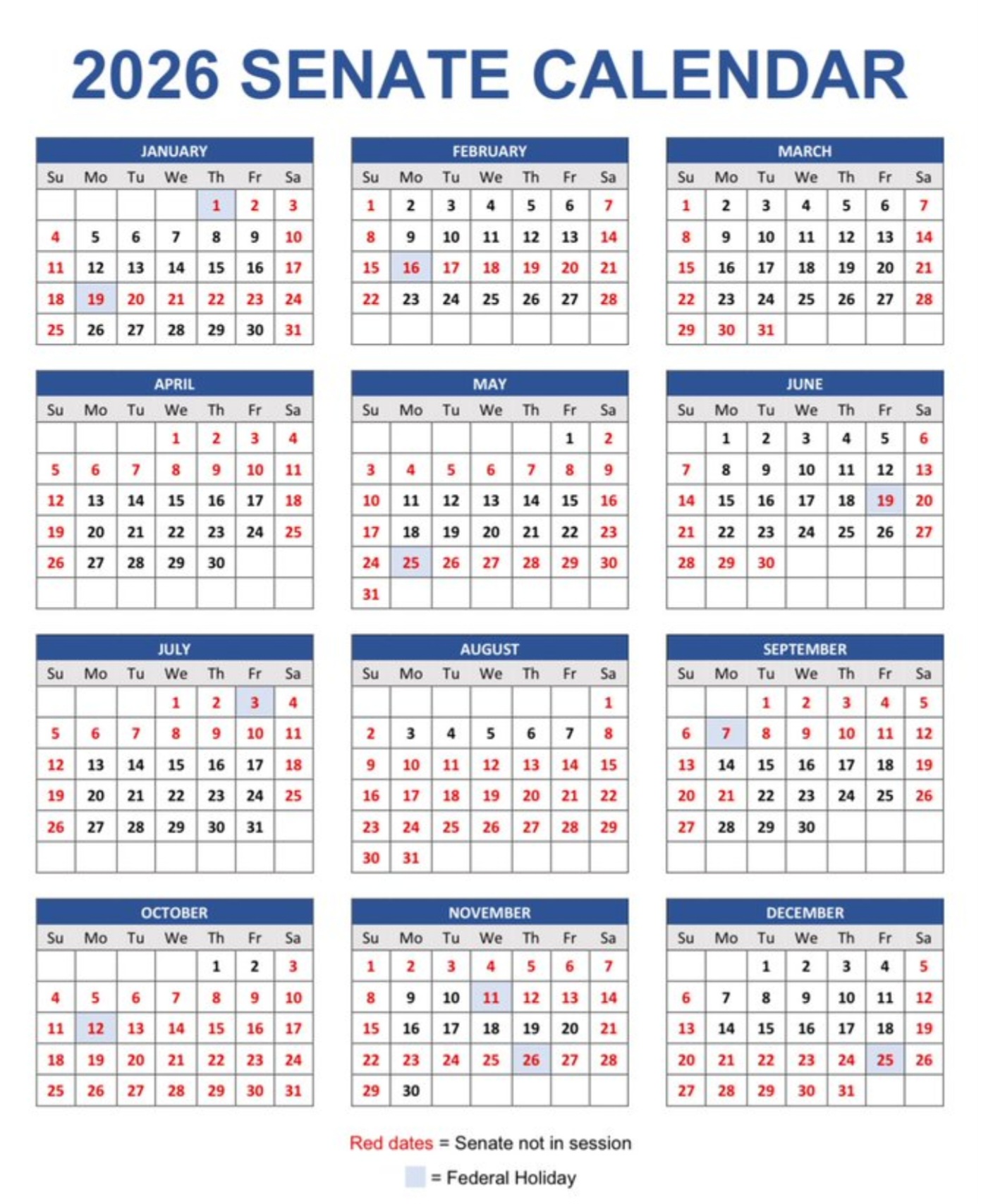
WASHINGTON — Congress is preparing for its annual summer slowdown, with lawmakers poised to leave Washington in August for a weeks-long stretch of work back home — or vacation — that will effectively pause the Capitol’s already strained legislative machinery.
According to the Senate’s tentative 2026 schedule, senators are slated to depart the Capitol at the end of the first full week of August, beginning an extended “state work period” that will run from August 10 through September 11. During that time, the chamber does not plan to hold regular floor votes or formal legislative business in Washington, instead shifting its focus to home-state events, constituent meetings and local political obligations.
The House of Representatives is expected to follow a similar pattern, even if its exact dates are less clearly marked. While the 2026 calendar released by House leaders lacks the detailed annotations that typically label “district work periods” and recess weeks, the chamber has long treated August as a de facto summer break from floor activity, returning only after Labor Day to resume legislative work. In recent years, that has meant most or all of August spent away from Washington, with members mostly on vacation or taking meetings around their districts.
In contrast to the month-long congressional summer vacation, around half of Americans say they’ll take a summer vacation in 2026, but four in ten or more are staying home, largely because of cost pressures and limited time off. Non‑travelers most often cite not being able to afford a trip, high travel costs and gas prices, and priorities like saving or paying down debt, with work constraints and family obligations also keeping people from getting away.”
The resulting summer lull in D.C. has become a staple of the congressional year, shaping the rhythm of policymaking in a capital increasingly driven by deadlines and crises. The weeks just before lawmakers depart often bring a flurry of activity such as last-minute appropriations markups, leadership-driven negotiations, and efforts to clear must-pass items before the break; followed by a stretch in which Washington’s focus turns outward, toward local concerns and the approaching general election cycle.
The national midterm election takes place on Tuesday, November 3rd this year. All 435 House seats and roughly one-third of Senate seats are on the ballot.
This year, the timing is especially significant. The 119th Congress faces a cramped calendar in the fall, when lawmakers will return from their August absence to confront a host of unresolved issues: the next round of government funding, ongoing debates over immigration and border policy, and the perennial question of whether leadership can marshal the votes needed to avoid shutdown drama. With floor time limited and partisan control of each chamber closely watched, every week in session will carry added weight.
Advocacy groups, lobbyists and grassroots organizers have also built their strategies around the August tradition. Many plan their legislative pushes with an eye toward the recess, seeing it as a chance to corner lawmakers on home turf — at district offices, community centers or factory floors — with targeted appeals on everything from health care and education funding to climate policy and veterans’ services. For them, a “district work period” is not a pause but a redeployment of pressure.
Still, the optics of a lengthy break can be fraught in a year marked by economic anxiety and political polarization. Critics routinely deride the August exodus as evidence of a part-time legislature, pointing to unfinished spending bills or stalled policy priorities as proof that Congress has not earned its time away. Lawmakers counter that the job has always had two distinct but intertwined fronts — Washington and the home state — and that neglecting the latter would only deepen public distrust of a body already suffering from chronically low approval ratings.
How the 2026 summer stretch unfolds will depend in part on what Congress manages to accomplish before members scatter in August. If major spending frameworks or bipartisan deals are left unresolved, the recess could serve as a long intermission before a bruising autumn fight. If party leaders can notch early wins, they may view the time back home as an opportunity to sell those achievements to skeptical constituents.
Either way, the calendar is set to shift. By mid-August, the frenetic pace of votes, press gaggles and late-night negotiations on Capitol Hill will yield to a quieter, more diffuse politics — one played out in school gymnasiums, union halls and small-town main streets across the country, where the work of Congress is debated far from the dome that symbolizes it.
But for many members, August brings a months-long vacation.